Sky · TV / Mobile / Gaming · 0→1 MVP → Platform

Trivial Minds

TVs on, phones ready, let the quiz begin. A multi-device quiz platform where the TV hosts and the phone runs the play. Shipped on Sky TV as Play Along in 2025, now Trivial Minds: one interaction system that re-skins per IP without rebuilding.

My Role
Lead Product UX Designer
Platform
TV (EntOS) + Mobile
Status
Live on Sky TV. MVP shipped 2025, rebrand and platform evolution 2026.
Year
2025–2026

Shipped, validated, and rebranded

Play Along launched on Sky TV as the first multi-device multiplayer quiz experience on the platform. Staff trials with 32 respondents validated the core interaction model before public release. Post-launch data confirmed sustained engagement, with sessions averaging over 8 minutes and roughly 1 in 3 launches resulting in a quiz being played. The MVP earned the runway to evolve: in 2026 the product was rebranded as Trivial Minds and the interaction model became the foundation of an IP-skinnable platform.

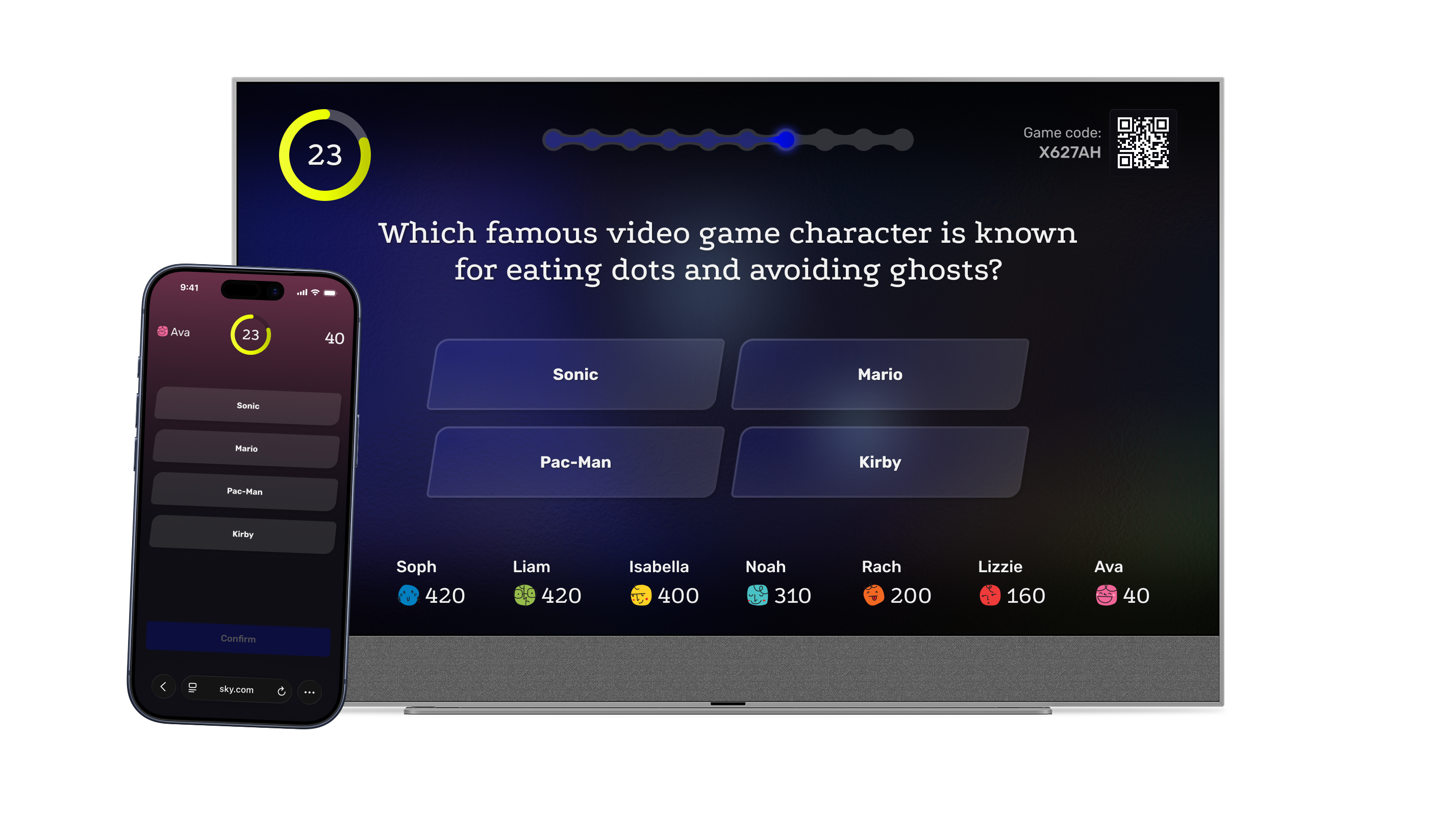
Play Along gameplay showing a quiz question on TV with the phone controller alongside
~30%
Launch-to-play conversion rate
~2-3
Average players per session
~8 min
Average session length

The problem space

Gaming is outpacing traditional TV: 16-34s now spend 114 min/day gaming, 82% of Comcast households are gamer households, and the industry is worth over $200bn. TVs are increasingly becoming gaming platforms through cloud gaming, removing all entry friction.

Sky had already proven the appetite for interactive TV, but no one had cracked a multiplayer, social quiz experience that bridged the TV screen with the phones already in everyone's hands.

We had the Millionaire app as a foundation, but the goal was to expand into casual gaming and open up the capability and IP to partners.

How might we turn passive TV time into interactive, shared moments that bring families and friends together in the living room?

The brief

  • Design a 0-to-1 multi-device quiz platform for Sky TV
  • TV acts as the host screen, phones become controllers
  • Modular enough to reskin for any IP
  • Simple enough that anyone can join in seconds
  • Social enough to make the living room feel like a game show

The constraints

  • Built on EntOS with web-based phone connectivity (no app install)
  • Support up to 8 players
  • TV remote only until the selection of the quiz
  • Scale from general knowledge to branded IP experiences without rebuilding

The interaction model

Four principles anchored every decision: modular, unite the living room, instinctive by design, inclusive for all. From those, three interaction calls shaped the whole dual-screen model. All three are mobile-first decisions: once the quiz starts, every player action happens on the phone, the TV stays as the host display.

TV as host, phone as controller

Once the host hits start, the TV runs the show. No remote fumbling, phones handle input.

Confirm before submit

A two-tap pattern (select, then confirm) prevents accidental answers when the countdown piles on pressure.

Attention ping-pong

Shared on TV, private on phone. Attention bounces between the two, with built-in pauses for reactions and banter. The TV anchors the room.

One frame, three zones

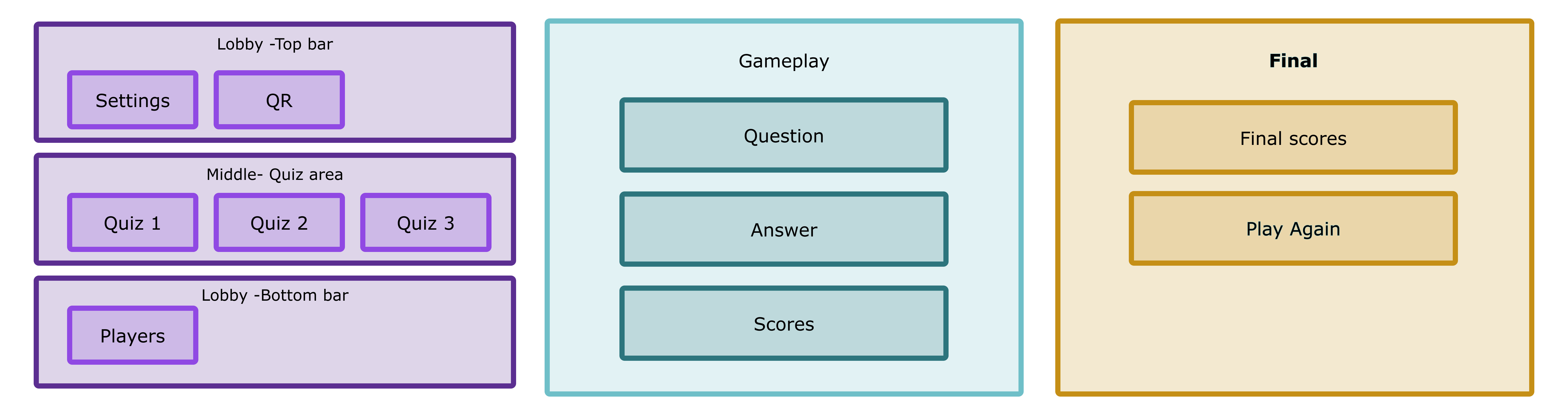
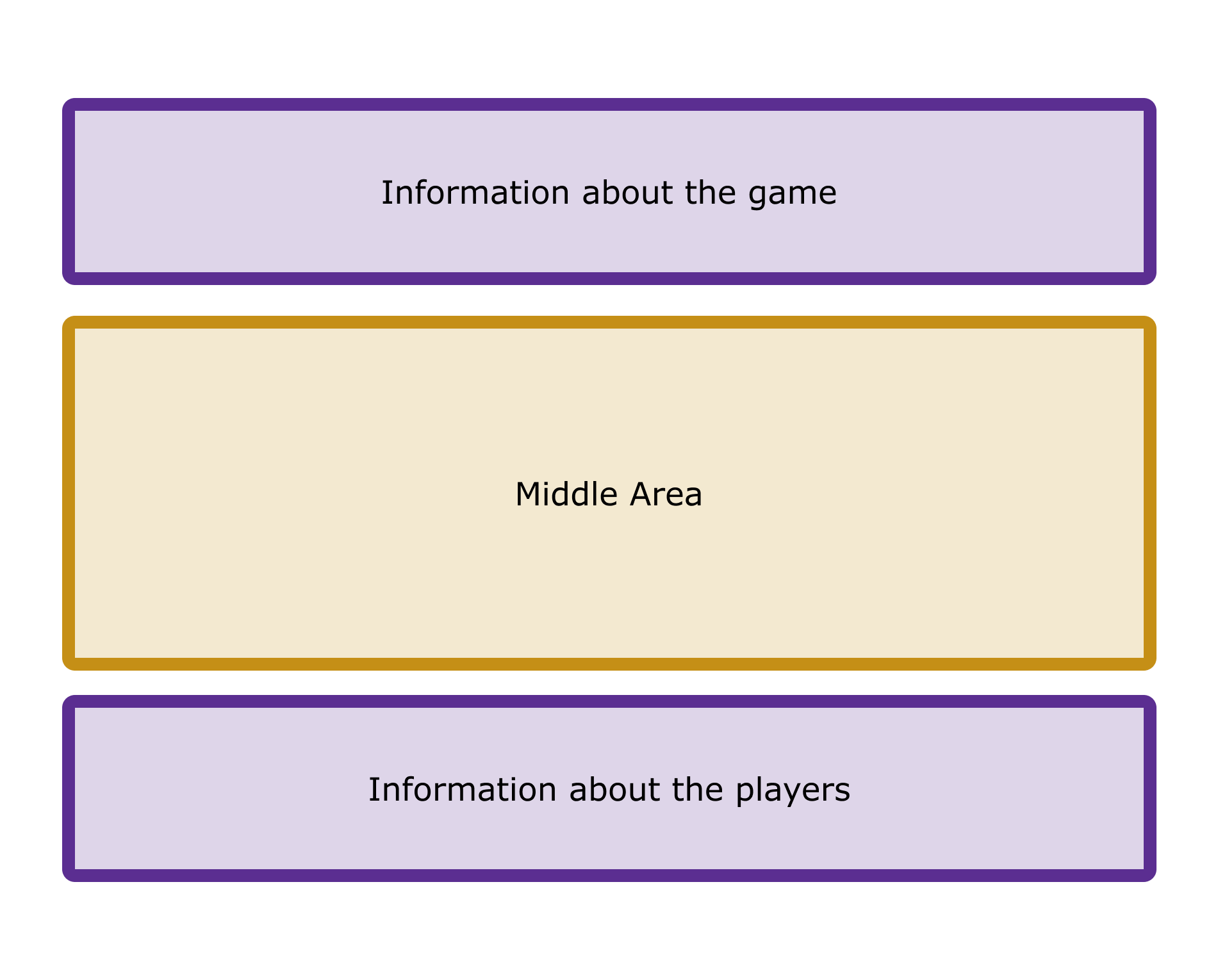
Three containers create the app experience, and the same structure carries across the whole app, so new quizzes and IPs plug into it without rebuilding the frame.

App structure

Three-zone app structure: top bar for game information, middle quiz area, bottom bar for player information

Top bar

Information about the game: timers, settings in the lobby, QR code, question number.

Bottom bar

Information about the players: number of players, names, and points.

Middle area

Where the action happens: quiz selection, the quiz itself (question and answers), and scores.

That same three-zone structure carries through lobby, gameplay, and final scores, so the frame never needs to be rebuilt as the screen changes.

Applied across the experience

The three-zone structure applied across lobby, gameplay, and final scores screens

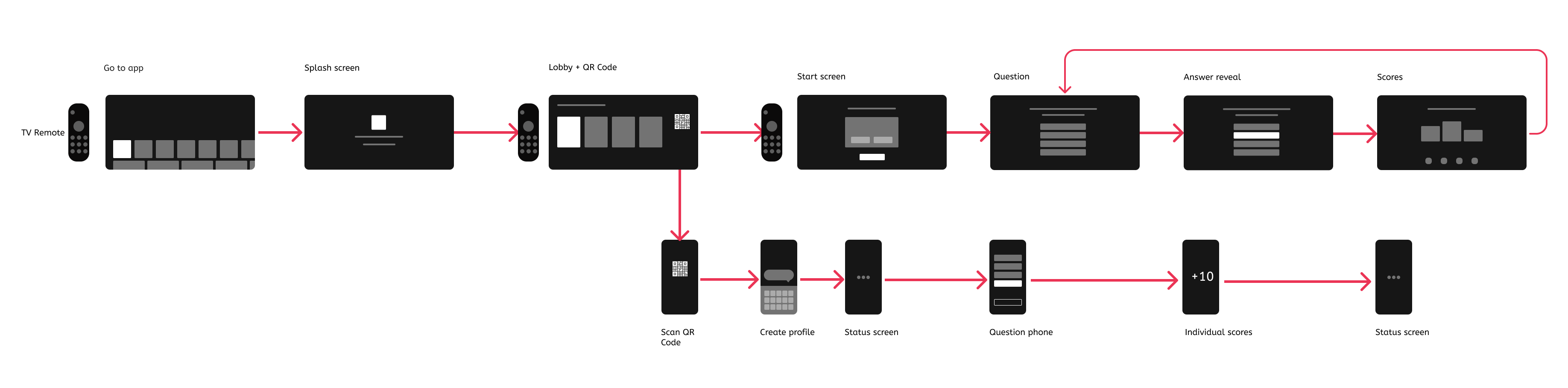
One TV, one phone: the shared and private split

The TV guides the room through the experience. It never requires input from a phone to progress, keeping the pace for the group.

Two-screen interaction model: the TV flow as the shared stage, with the phone controller alongside

Key decisions and trade-offs

Confirm before submit, not auto-submit

Most mobile games auto-submit: tap and it locks in. After competitor research, we chose select-then-confirm. With a countdown running and people shouting across the room, misclicks are constant, so the extra tap protects the player from an irreversible mistake at second 3.

QR code, not a typed room code

The MVP shipped QR only: faster to build and no typing on a TV remote D-pad. A typed code sits in the roadmap as a v2 fallback for contexts where a scan isn't practical.

Persistent top and bottom bars

Following established TV UI patterns: orientation at the top, social presence at the bottom, a flexible main area between. Defined in the IA as modular zones, so new quizzes and IPs plug in without rebuilding the frame.
Shaping constraints and failure states with Product and Engineering

8-player cap
Set deliberately to match what fits comfortably on a TV and the typical living-room group size.
No-app-install requirement
Defined by the Head of Product for launch. I partnered with the Senior UI Designer on the visual system and the Senior Game Designer on gameplay rhythm and pacing.
Cross-functional alignment
Most collaboration ran through the CPS-Blue engineering team. The confirm-before-submit pattern required their buy-in because it introduced a new state to the answer flow. Framing it as player protection, not added friction, turned it into a shared decision rather than a design preference.
Failure-handling for a live, networked quiz
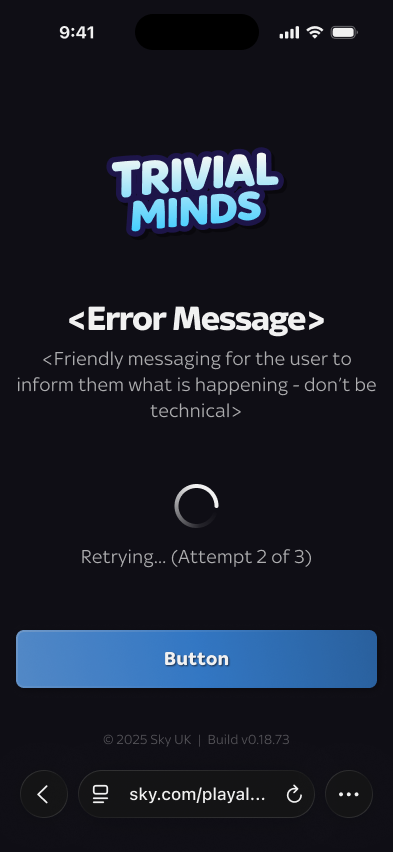
Unlike static screens, a real-time quiz can fail in multiple ways. Together with engineering, we mapped ~12 error scenarios and designed a graceful fallback for each, prioritising the connectivity cluster first (5xx errors, WebSocket timeouts, failed asset loads) as the highest-stakes failures to get right.

One error template, ~12 scenarios

Trivial Minds full-screen error template, with placeholder message, retry indicator, and button

Working with the CPS-Blue engineering team, I defined a unified failure-handling model by mapping twelve potential error states and creating a single full-screen template for any issue that halted the experience, ensuring consistent messaging and predictable recovery paths.

Non-blocking scenarios like a full room or a rejected player name were intentionally handled through lightweight notifications instead, preserving room flow while still giving the affected player immediate, actionable feedback.

What v2 unlocked

The MVP earned its place, but the launch-to-play conversion rate told us something specific: the first ten seconds were the problem, not the content. From January to May 2026 the product moved from a single MVP into a platform direction, with a rebrand at the centre of it.

Rebrand to Trivial Minds

In April 2026 we rebranded from Play Along to Trivial Minds. The new name reframed the product from a feature inside Sky's catalogue into a standalone IP that could host other IPs underneath it.

One flexible system across IPs

The interaction model and UI framework were built to re-skin per IP, from general knowledge to branded experiences, without rebuilding the core. One platform, many quizzes.

The MVP proved the interaction. The platform is what the interaction earned.

The v2 UI refresh was led by the Senior UI Designer, with motion design by the Lead Interaction Designer. I focused on the interaction architecture, the drop-off discovery, and reframing the product as a platform capability.

What I took from it

Orchestrating attention

Getting the rhythm right between TV and phone in a shared room.

From product to capability

Designing a reusable platform, not just a single experience.

Validation-driven iteration

Test early, listen closely, prioritise ruthlessly.

What I'd change

v1 shipped barebones. The interaction model held, but the UI in several flows was thinner than we'd have shipped with more time. The rebrand to Trivial Minds is where that gap closes, with a refreshed UI and motion system layered onto the same interaction model. The lesson: planning the capability architecture from day one, rather than retrofitting it after v1, would have saved us rebuilding for v2.

← All case studies Next: Sky Live's Watch Together →